





In the first decades of the 20th century, Maxfield Parrish occupied a position few artists have held since. His work was not only widely known—it was widely owned. Reproductions of paintings like Daybreak circulated in large numbers, appearing in middle-class homes across the United States at a scale that blurred the line between artwork and furnishing.
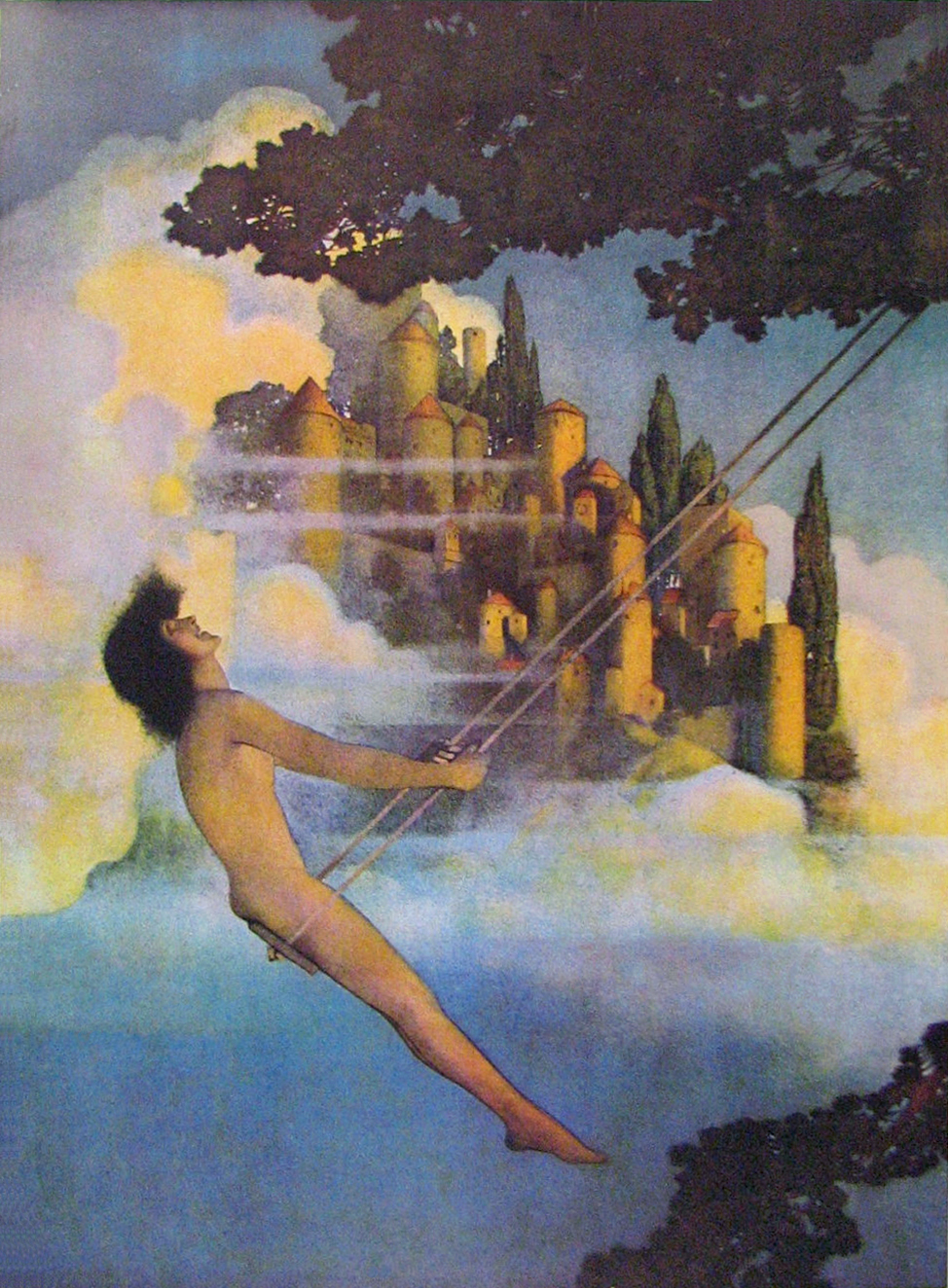
That kind of visibility shaped how his work was understood from the beginning. Parrish was trained within academic traditions, and his early paintings show a careful attention to composition, architecture, and light. But his career developed alongside expanding print industries, and he moved easily between painting, illustration, and commercial commissions. His images were not confined to a single context; they were designed, from early on, to function across several. This adaptability was supported by his working method. Parrish constructed his images in stages, using models, props, and photography before translating them into paint through layered glazing. The process allowed for a high degree of control. Light is stable, color is saturated but contained, and compositions resolve cleanly. Whether in The Sugar-Plum Tree or Interlude, the same qualities recur: figures placed within clearly defined spaces, environments that feel complete rather than open-ended.
These qualities contributed directly to his popularity. The images are legible at a glance and retain their structure when reproduced. At a moment when printed images were becoming more common, Parrish’s work proved especially suited to circulation. His paintings could move into magazines, books, and calendars without losing their coherence.
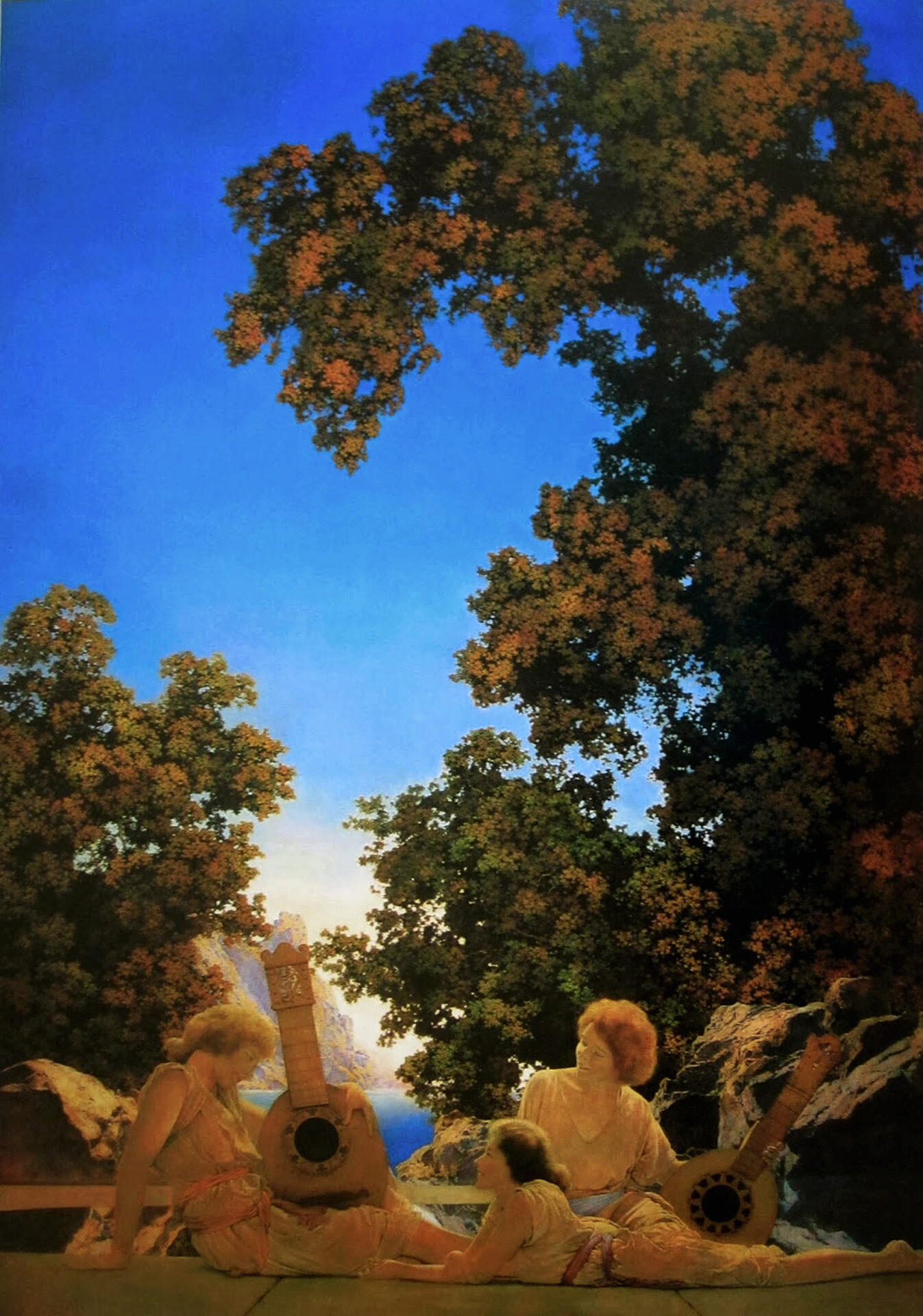
By the 1920s, this circulation had become central to his reputation. Parrish was one of the most commercially successful artists in the United States, and his work reached audiences far beyond those who encountered painting in galleries. That reach, however, also positioned him differently from many of his contemporaries.
As critical attention in the mid-20th century shifted toward modernism, the criteria for evaluating painting changed. Emphasis moved toward abstraction, material presence, and visible process. In that context, Parrish’s work—precise, controlled, and widely reproduced—began to appear overly resolved. The same qualities that had supported its circulation were now read as limitations. The term “kitsch” became a way of describing this shift. It did not refer only to subject matter or style, but to the conditions under which the work was seen. Images that had become familiar through reproduction were harder to position within a framework that valued difficulty and singularity. Parrish’s popularity, once an asset, complicated his standing.
.jpg)
It is also important to note that Parrish’s work changed relatively little over time. While he refined his approach—particularly in his handling of light and color—he did not move through the kinds of stylistic transformations that defined many modernist careers. Works like Contentment continue the same compositional logic established earlier: balanced figures, contained environments, and a consistent palette shaped through glazing. This continuity reinforced the sense that his work operated within a fixed system. Yet that same consistency can be understood differently. Rather than indicating a lack of development, it reflects a sustained commitment to a particular way of making images—one that prioritized clarity, control, and reproducibility. Parrish’s paintings were not experiments in process; they were finished constructions intended to hold their form across different contexts.
In recent decades, this aspect of his work has been reconsidered. As the boundaries between fine art, illustration, and design have become less rigid, Parrish’s ability to move between them appears less anomalous. His widespread reproduction no longer reads solely as dilution, but also as evidence of how effectively his images functioned within a changing visual culture. Parrish’s career illustrates a persistent tension in art: the relationship between popularity and critical value. His work did not disappear because it failed to resonate. It became difficult to place because it resonated too broadly, and too consistently, at a moment when the terms of evaluation had shifted.
Seen now, his paintings remain what they always were—carefully constructed images that were built to endure, not only as objects, but as presences in everyday life.