





Auckland Art Gallery Toi o Tāmaki has named the four finalists for the 2027 Walters Prize, marking the latest iteration of what is widely regarded as Aotearoa New Zealand’s most significant award for contemporary art. Established in 2002 and awarded every three years, the prize continues to function as both a barometer and a catalyst for contemporary practice in the country.

Edith Amituanai, Vaimoe (video still), 2024. Digital video, sound.
Cinematographer: Ralph Brown. Photo credit: Ralph Brown
The 2027 shortlist spans photography, installation, moving image, and interdisciplinary exhibition-making, reflecting a period shaped by geopolitical instability and environmental strain. Rather than foreground spectacle, the selected works attend closely to lived experience, material experimentation, and local narratives—an approach the jury identified as central to this year’s selection. The finalists were chosen from works first exhibited between February 2023 and February 2026 by a jury comprising Tyson Campbell, Abby Cunnane, Becky Hemus, and Hanahiva Rose.
Edith Amituanai, a Tāmaki Makaurau-based Samoan artist known for her photographic practice, is nominated for Vaimoe (2024), originally presented in Toloa Tales at Christchurch Art Gallery Te Puna Waiwhetū. Her work continues an ongoing engagement with community portraiture and the social textures of diasporic life.
Richard Frater, a Berlin-based artist, is recognised for Nicky’s conversion (2024), first shown at Klosterruine Berlin and later in Auckland. Frater’s practice often merges installation, performance residue, and narrative structures that move between personal and fictional registers.
Ammon Ngakuru, working in Auckland, is shortlisted for Three Scenes (2025), a commission for Auckland Art Gallery itself. His work frequently draws on cinematic language and spatial composition, staging moments that sit between constructed fiction and observational reality.
Sorawit Songsataya, a Thai-New Zealand artist based in Bangkok, is nominated for Fibrous Soul (2024), exhibited at Govett-Brewster Art Gallery. His interdisciplinary practice explores biological systems, ecology, and speculative futures through sculptural and installation formats.
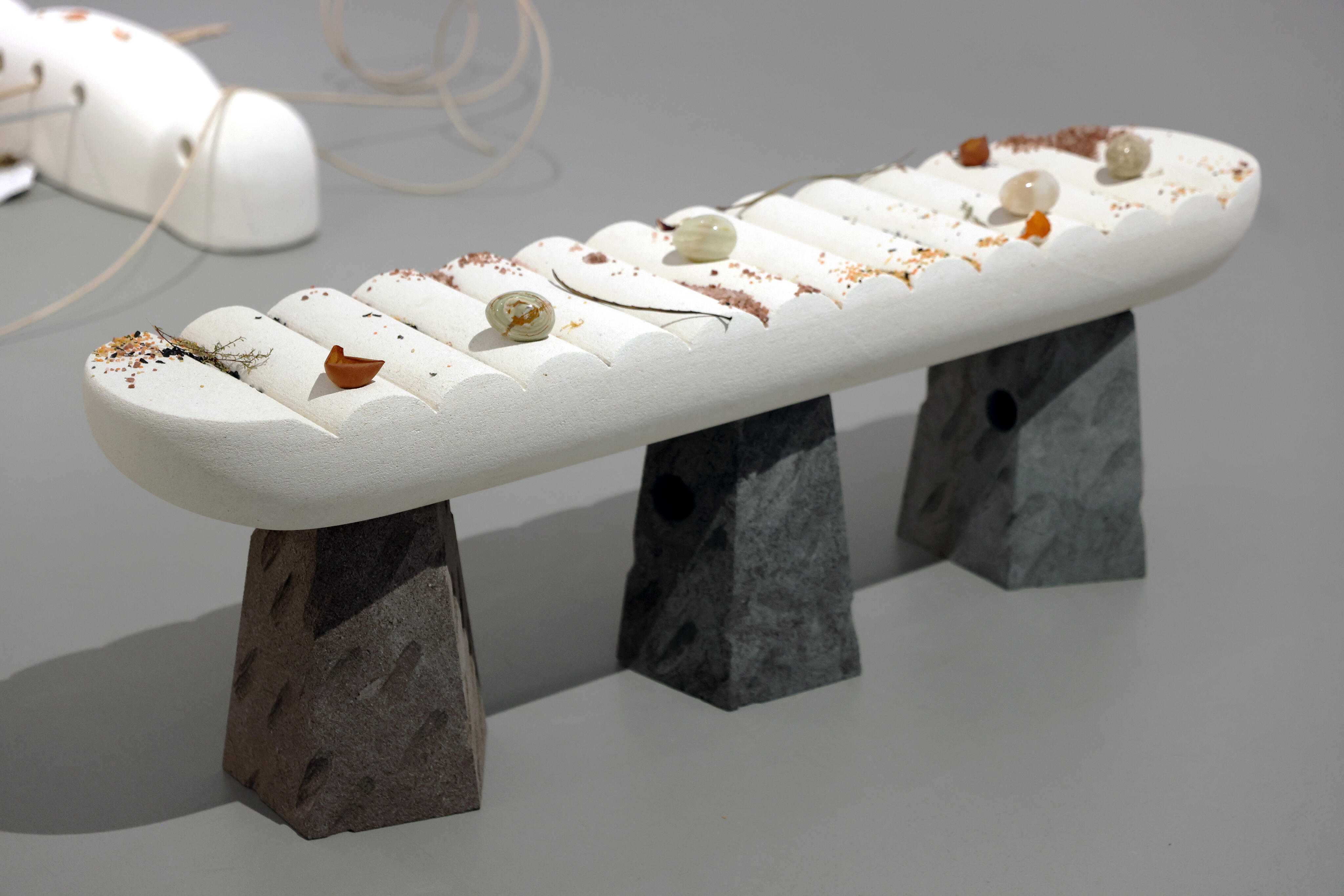
Sorawit Songsataya, Ranad detail from the exhibition Fibrous Soul, 2024. Taranaki andesite, Ōamaru limestone, onyx, dried plant.
Taranaki andesite carving by Donald Buglass. Photo courtesy of the artist and Govett-Brewster Art Gallery
In a joint statement, the jury positioned the shortlisted works within a broader global context, noting that the past three years have been “marked by political unrest, escalating conflicts, and environmental devastation.” Rather than responding through scale or immediacy, the selected artists turn toward “local and personal narratives,” expanding both material and conceptual approaches to art-making. This emphasis signals a shift away from overtly declarative gestures toward practices that accumulate meaning through specificity—whether in Amituanai’s attention to community, Ngakuru’s constructed scenes, or Songsataya’s ecological inquiry. Dr Zara Stanhope, Director of Auckland Art Gallery, described the shortlist as indicative of “the breadth and range of art across Aotearoa New Zealand,” pointing to a generation of artists actively reshaping the cultural landscape. Senior Curator Natasha Conland, who will oversee the 2027 exhibition, emphasised the material and conceptual diversity of the works. She noted that each artist brings a “unique, often humorous and intellectually rewarding” approach, underscoring the role of the exhibition as a site for public engagement as much as critical discourse. The finalists will present either new or adapted versions of their nominated works in a group exhibition opening in March 2027 at Auckland Art Gallery Toi o Tāmaki. As with previous editions, the exhibition is designed not only as a presentation of individual practices but as a forum for dialogue within New Zealand’s cultural sector.
An international judge—yet to be announced—will travel to Aotearoa to select the winner, continuing a tradition that situates the prize within a global critical framework while remaining grounded in local production. Recent winners include Ana Iti in 2024, selected by Bonaventure Soh Bejeng Ndikung, and the joint award to Mataaho Collective and Maureen Lander in 2021. Each iteration of the Walters Prize has traced shifts in artistic priorities across the country, from institutional critique to Indigenous methodologies and collaborative practice.
The 2027 shortlist extends this trajectory, foregrounding artists whose work resists singular categorisation while remaining closely tied to place, material, and lived experience.